
Gardener Kenton — Recycling and Sustainability for an Eco-Friendly Waste Disposal Area
Gardener Kenton champions a low-impact approach to green space care and the sustainable rubbish gardening area that serves the local community. Our ethos is to blend traditional horticultural care with modern resource management so that every soil heap, pruned branch and garden refuse collection contributes to a circular economy. This page outlines our targets, partnerships and practical infrastructure for responsible waste and recycling in Kenton and the surrounding boroughs.We operate with a clear recycling percentage target: to achieve 70% recycling and reuse of collected green and household-compatible materials by 2030. That target covers diverted green waste, composted material, wood reuse and item refurbishment. Gardener Kenton tracks progress annually and reports on diversion rates, greenhouse gas reductions and the tonnage sent to local transfer stations for processing. By prioritising reuse and composting we reduce landfill and create nutrient-rich outputs for local allotments and community gardens.
 Our operational model integrates with borough-level approaches to waste separation; most local councils now separate food waste, garden (green) waste and dry recyclables such as glass, paper, plastics and metals. We work directly with household collections and community drop-offs so that materials enter the correct streams. Collaboration with nearby transfer stations ensures that bulky garden waste and mixed loads are sorted and processed effectively, reducing contamination and improving recycling yields.
Practical Recycling Activities and Local Transfer Stations
We maintain strong links to transfer stations and civic depots in the boroughs surrounding Kenton (including facilities serving Brent and Harrow). These transfer stations accept segregated green waste, bulky items and reusable goods for onward processing. Key steps in our local recycling activity include:- Segregated green waste collection — separate garden cuttings and woody material for composting or biomass processing.
- Bulky item sorting — salvageable furniture, planters and tools redirected to charity partners.
- Textiles and small electricals — routed through community collection points in line with borough textile and WEEE schemes.
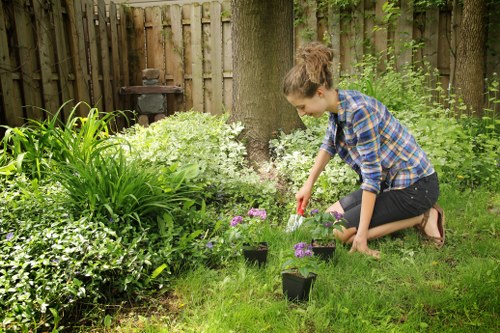 Partnerships with charities and social re-use networks are central to our reuse strategy. Gardener Kenton collaborates with local charities, community allotments and social enterprises to repair, upcycle and redistribute items that still have life — from wooden planters to gardening tools and surplus soil conditioners. These partnerships keep useful items circulating locally and support social value by providing training, low-cost resources and volunteering opportunities.
Our links with community composting hubs help convert garden waste into usable compost and soil improvers for residents and community orchards. We also support charitable reuse for bulky waste through formal handover processes at transfer stations where charities can collect suitable items, reducing the burden on municipal disposal and increasing the proportion of materials kept in productive use.
Low-Carbon Fleet and Sustainable Rubbish Gardening
To minimise transport emissions and model a low-impact service, Gardener Kenton operates a fleet of low-carbon vans: electric vehicles for local rounds and hybrids for longer or heavier runs. The shift to electric and plug-in hybrid vans reduces tailpipe emissions and noise in residential neighbourhoods while enabling frequent collections to keep green bins and composting facilities well managed.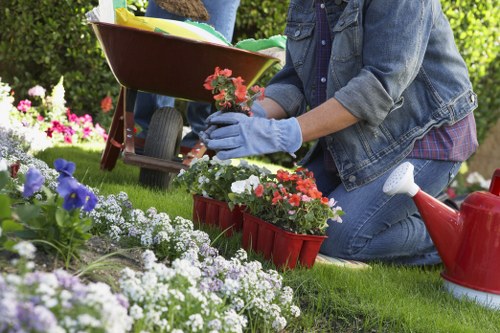 Operational efficiency is as important as vehicle choice. Route optimisation, consolidated drop-offs at borough transfer stations and scheduled charity pickups maximise load factors and reduce miles travelled. We coordinate with local civic waste teams so that garden waste and recyclable materials are delivered to the most appropriate processing facility, whether that is a municipal composting plant, an energy-from-waste facility for residuals or a charity reuse centre.
 Monitoring, targets and continuous improvement — our monitoring framework tracks recycling percentages, contamination rates and carbon emissions from collections. We publish annual summaries of our performance against the 70% recycling target and document initiatives that increase diversion rates, such as community reuse fairs, targeted bulky waste collection events and partnership expansions with local non-profits.
Gardener Kenton’s approach to an eco-friendly waste disposal area and sustainable rubbish gardening area is built on clear goals, accountable reporting and hands-on collaboration with borough services and charitable organisations. We respect the boroughs' waste separation guidelines, support community composting, and invest in low-emission logistics to protect air quality while improving recycling outcomes.
By combining best-practice recycling activity, strategic use of transfer stations and meaningful charity partnerships, Gardener Kenton creates value from materials that would otherwise be discarded. Our sustainable rubbish gardening area emphasises reuse, habitat-friendly disposal, and producing useful outputs for local green spaces.
Our commitment: maintain a resilient, low-carbon service that diverts as much material as possible from landfill, supports the boroughs’ separation schemes, and channels repaired and reusable goods back into the local community. This sustainable model helps ensure that gardening and green space maintenance in Kenton are genuinely restorative and resource-efficient for years to come.